
Paralegals play an integral role in the delivery of legal services and often handle much of a lawyer’s workload, drawing on an advanced understanding of the legal system. To become an expert in the law, you’ll first need to earn a paralegal degree that meets your state’s requirements and fits your personal career goals. Learn what kind of paralegal education you’ll need to get started in this rewarding career.


A Community of Professors and Practicing Paralegals
Much of what you’ll read across this site comes straight from people who actually do this work. We’ve interviewed paralegal program faculty and directors at schools nationwide, gathered insights from practicing paralegals and an attorney in the field, and reviewed hundreds of programs at every degree level.
Paralegal Professors From 43 Schools Interviewed
Paralegal Program Reviews at the Certificate, Associate, and Bachelor’s Level
Practicing Professional Contributors, Including 5 Paralegals and 1 Attorney
One of the most experienced voices in the group spent years as a professor in a respected university program before serving as chairperson of the American Bar Association Standing Committee on Paralegals.

Emerita Faculty, Tulane University School of Professional Advancement · Chair, ABA Standing Committee on Paralegals
Robyn spent years directing Tulane’s General Legal Studies program before moving to emerita status. She previously chaired the American Bar Association’s Approval Commission for paralegal programs and now chairs the ABA Standing Committee on Paralegals, overseeing the review and approval of paralegal programs nationwide, including many of the schools featured on this site.
Interviewed for our faculty series. Not an author of this site.
Explore the full interview series to hear directly from faculty at all 43 schools.
What Is a Paralegal?
A paralegal is an expert law assistant who helps practicing attorneys with legal tasks and provides general legal support to businesses. What paralegals can’t do, in any state, is offer opinions or legal advice, represent clients in court, accept new clients into the practice, or set legal fees. These are things that fall strictly within the purview of a licensed attorney.
What Does a Paralegal Do?
The scope of work for a paralegal is broad, offering opportunities to delve into nearly every facet of the legal profession. Paralegals may perform administrative duties, especially in a small office. However, because paralegals typically earn higher wages than legal secretaries, many offices reserve paralegals’ time for more specialized tasks. A paralegal may:
- Draft agreements, contracts, and briefs
- Evaluate potential clients for case viability
- Meet with clients to help with paperwork
- Parse out details from case law
- Prepare exhibits for a trial and assist the practicing litigator in the courtroom.
- Assist in administrative law hearings; in limited cases and jurisdictions, may represent clients under agency-specific rules.
- Review the legal language in the contract document.s
Paralegals often interface with a variety of people and are expected to be good communicators, strong writers, and adept at conflict resolution and negotiation. This breadth of work means that paralegals can work in a variety of industries outside of strictly case law, including healthcare, business, immigration, intellectual property, real estate, personal finance, and more.
Paralegal Degrees and Certificates
What does a paralegal do to enter the profession? First, you’ll need to complete your paralegal education, then garner applicable legal experience through an internship or an entry-level position. The paralegal degree you earn depends heavily on what kind of law career you wish to have.
- Certificate: A generalist paralegal certificate can be a good choice if you’re a high-school graduate looking to get an entry-level job in law before or while pursuing a higher degree.
- Associate: An associate paralegal degree is an excellent option for students new to the field who wish to work at a law firm, or for someone switching careers and already holds a degree in a different area but has no specific paralegal education.
- Bachelor’s: A bachelor’s in paralegal studies will provide you with a robust education in the requirements for your field. You’ll complete an internship to practice your skills under the tutelage of paralegals in the field.
- Post-Degree Certificate: A post-associate or post-baccalaureate certificate is an ideal option for career changers and degree-holding paralegals seeking to specialize.
- Master’s: Once you’ve earned your bachelor’s in paralegal studies, you may wish to specialize your skills and knowledge even further. A paralegal master’s degree or a Master of Legal Studies allows you to focus on a specific area of law to gain expertise in its procedures and principles.
How Long Does It Take to Become a Paralegal?
The time required to become a paralegal depends on your current education level and career goals. Here’s a comparison of the most common educational paths:
| Degree Type | Duration | Total Cost Range | Best For |
|---|---|---|---|
| Certificate | 6-12 months | $3,000-$8,000 | Career changers with a bachelor’s degree in another field |
| Associate Degree | 2 years | $6,000-$20,000 | New students entering the legal field |
| Bachelor’s Degree | 4 years | $40,000-$120,000 | Comprehensive education and career advancement opportunities |
| Post-Degree Certificate | 6-18 months | $3,000-$10,000 | Specialization in a specific area of law |
| Master’s Degree | 1-2 years | $20,000-$60,000 | Advanced specialization and management roles |
Most paralegal programs include practical components, such as internships or externships, where you’ll gain hands-on experience in legal settings. These experiences are valuable for building skills and making professional connections before you enter the job market.
ABA-Approved Paralegal Programs
Getting the proper paralegal education is key to your future in law, so it’s critical to find a program that the American Bar Association approves. ABA-approved paralegal programs are thoroughly vetted and ensure high-quality coursework. You can find ABA-approved programs at both community colleges and four-year universities, depending on which paralegal degree or certificate you’re pursuing.
ABA approval matters because it signals to employers that your education meets rigorous national standards. Many federal positions and specialized legal roles specifically require or strongly prefer candidates with degrees from ABA-approved programs.
Robyn Ice, whom you met above, put it well when talking about her own ABA-approved program:
Faculty Voice
“Due to the long and successful history of our ABA-approved program, we have an excellent pool of participating law firms to which we can assign student interns.
Paralegal Certification
As a paralegal, you also have the option to pursue national certification. Paralegal certification can help set you apart from your peers and demonstrate a deep commitment to your profession. What is a paralegal certification? It’s a voluntary credential that you can earn by testing through one of four nationally recognized organizations:
- The National Association of Legal Assistants (NALA)
- The National Federation of Paralegal Associations (NFPA)
- The Association for Legal Professionals (NALS)
- The American Alliance of Paralegals, Inc. (AAPI)
Requirements vary by state. Most traditional paralegal positions don’t require a state-issued license or a single nationwide certification exam. However, some states set their own qualifications for people using the paralegal title or doing paralegal work, and a few license limited-scope legal paraprofessionals under separate state-specific rules. Earning voluntary certification still demonstrates your expertise and commitment to professional standards, which can increase your earning potential and job opportunities.
Paralegal Salary and Job Outlook
According to the US Bureau of Labor Statistics, paralegals and legal assistants earned a median annual salary of $62,890 as of May 2025, or $30.24 an hour. Pay varies widely across the field: the middle 80% earned between $44,740 and $101,500 a year ($21.51 to $48.80 an hour), a range that reflects differences in market, employer, and specialization rather than a straightforward experience ladder.
Salary varies significantly by location, specialization, and experience level. Paralegals working in metropolitan areas such as San Francisco, New York, and Washington, D.C., often earn considerably more than the national median. Corporate paralegals and those specializing in complex areas like intellectual property or securities law also tend to command higher salaries.
The BLS national outlook for paralegals and legal assistants calls for little or no change in employment through 2035, with employment projected to shift from 404,900 to 403,800 jobs. Even with that flat outlook, the profession still adds about 40,800 average annual openings, driven mainly by people leaving the occupation rather than newly created positions. BLS points to advances in technology, including AI, as one factor tempering demand growth.
For detailed salary information by state and city, visit our paralegal salaries page.
Paralegal Careers
Paralegals are increasingly recognized for their ability to develop expertise and offer a comparable set of services to fully-fledged lawyers. This is leaving the job market wide open to significant opportunities in many industries, and a range of paralegal salaries to match. While many paralegals work in law firms, many others work at government agencies, non-profits, and corporations. A few examples of paralegal careers include:
- Criminal law paralegal: A paralegal focused on criminal law may work with an attorney’s office, for a judge or justice, for a special interest group, or for local, state, or federal government as an assistant to a district attorney or Attorney General.
- Corporate paralegal: In this capacity, you’ll provide legal expertise to businesses on transactions such as investments, mergers, acquisitions, business filings, and more, ensuring that the corporation’s dealings comply with the letter of the law.
- Bankruptcy paralegal: Another branch of business law, bankruptcy paralegals help companies navigate the federal bankruptcy process to obtain debt relief.
- Litigation paralegal: A litigation paralegal has specific expertise in the rules and processes of bringing proceedings to court, criminal or otherwise.
- Personal injury paralegal: When dealing with cases involving physical and emotional pain, a personal injury paralegal must have a deep degree of empathy in addition to their legal expertise.
Get on Board with a Promising Career as a Paralegal
Paralegal careers evolve with the practice of law, but trends indicate that paralegals will be even more critical in both law firms and corporations. Their status as the right hand to practicing attorneys has been cemented in the legal field, and their business value is being proven daily.
With such a promising outlook, there’s no better time to start your paralegal education. Find an approved program today and join the next generation of law experts who are making a difference.
Find out more about how you can become a paralegal.
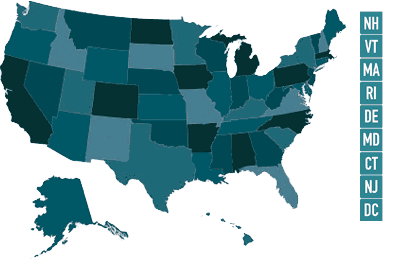
Find Info For Your State
- Alabama
- Alaska
- Arizona
- Arkansas
- California
- Colorado
- Connecticut
- Delaware
- District of Columbia
- Florida
- Georgia
- Hawaii
- Idaho
- Illinois
- Indiana
- Iowa
- Kansas
- Kentucky
- Louisiana
- Maine
- Maryland
- Massachusetts
- Michigan
- Minnesota
- Mississippi
- Missouri
- Montana
- Nebraska
- Nevada
- New Hampshire
- New Jersey
- New Mexico
- New York
- North Carolina
- North Dakota
- Ohio
- Oklahoma
- Oregon
- Pennsylvania
- Rhode Island
- South Carolina
- South Dakota
- Tennessee
- Texas
- Utah
- Vermont
- Virginia
- Washington
- West Virginia
- Wisconsin
- Wyoming
Frequently Asked Questions
How long does it take to become a paralegal?
The time required depends on your chosen educational path. Certificate programs take 6-12 months, associate degrees require 2 years, and bachelor’s degrees take 4 years to complete. If you already have a bachelor’s degree in another field, a post-degree paralegal certificate is the fastest route at 6-18 months.
Do I need certification to work as a paralegal?
Most states don’t require traditional paralegals to hold a state-issued license or national certification, though state-specific qualification rules apply in some jurisdictions. Voluntary national certification from organizations like NALA or NFPA is valued by employers and can increase your salary and job opportunities. Many paralegals pursue certification after gaining some work experience.
Can I become a paralegal without a degree?
While some states allow it, most employers prefer or require formal paralegal education from an ABA-approved program. Without a degree, you may be limited to legal secretary or assistant positions. Investing in at least a certificate program significantly improves your career prospects and earning potential.
What’s the difference between an associate’s and a bachelor’s degree in paralegal studies?
An associate degree provides foundational paralegal skills and takes 2 years to complete. It’s sufficient for entry-level positions at most law firms. A bachelor’s degree offers a more comprehensive education, including broader legal theory, business courses, and advanced specializations. Bachelor’s degree holders often have better advancement opportunities and higher starting salaries.
Are online paralegal programs legitimate?
Yes, many accredited and ABA-approved paralegal programs offer online options. Online programs provide flexibility for working adults while maintaining rigorous academic standards. Look for programs that are regionally accredited and, ideally, ABA-approved, and ensure they include practical components like internships or externships.
How much do paralegal programs cost?
Costs vary widely by program type and institution. Certificate programs typically cost $3,000-$8,000, associate degrees range from $6,000-$20,000, and bachelor’s degrees can cost $40,000-$120,000. Community colleges and online programs are often more affordable options. Don’t forget to research scholarships and financial aid opportunities.
What’s the job outlook for paralegals in 2025?
The US Bureau of Labor Statistics projects little or no change in paralegal employment through 2035, though the profession still adds about 40,800 average annual openings, mostly as workers leave the field. Job prospects are strongest for candidates with formal education, certification, and technology skills, including legal research databases and case management software.
Key Takeaways
- Paralegal education ranges from 6-month certificates to 4-year bachelor’s degrees, with programs available at various price points to fit different budgets and timelines.
- ABA-approved programs ensure quality education that meets national standards and is recognized by employers, particularly for federal and specialized positions.
- National certification from NALA or NFPA is voluntary but valuable, demonstrating professional commitment and often leading to higher salaries.
- Most states don’t require paralegal licensing, but formal education and credentials significantly improve job prospects and career advancement.
- Paralegals earn a median annual salary of $62,890 as of May 2025, with higher earnings in metropolitan areas and specialized practice areas.
- The BLS national outlook calls for little or no change in employment through 2035, with about 40,800 average annual openings as law firms and corporations continue to rely on paralegal expertise.
Ready to Start Your Paralegal Education?
Explore ABA-approved programs in your state and compare certificate, associate, and bachelor’s degree options to find the path that fits your career goals.
May 2025 US Bureau of Labor Statistics salary figures for Paralegals and Legal Assistants. National 2025-35 employment projections from the US Bureau of Labor Statistics Employment Projections program. Figures reflect national data, not school-specific information. Conditions in your area may vary. Data accessed September 2026.