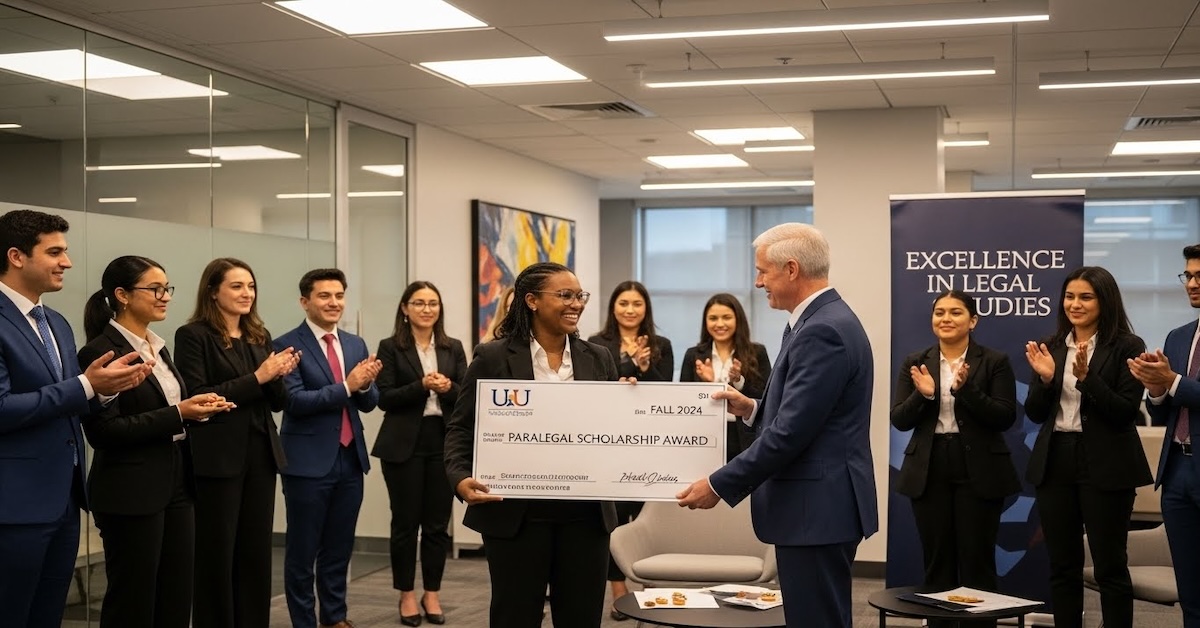

Paralegal scholarships usually run from a few hundred dollars to several thousand. National awards come from NFPA and AAfPE, and state associations, law firms, and individual schools fund the rest. Amounts and deadlines shift every cycle, so confirm both with the sponsor before you build an application around them.
Paralegal education costs anywhere from $3,000 for a community college certificate to $40,000 or more for a bachelor’s degree. That’s a significant investment, but you don’t have to cover it alone. Scholarships can reduce your out-of-pocket costs substantially, and many awards receive surprisingly few applicants.
This guide covers more than 30 funding sources open to paralegal students in 2026, along with what we could and couldn’t confirm about each one. You’ll find national awards from professional associations, state and local opportunities that often go overlooked, law firm scholarships, and school-based funding options. Whether you’re pursuing a certificate, associate degree, or bachelor’s in paralegal studies, there’s financial aid explicitly designed for your path.
We’ve also included application strategies, deadlines, and funding options for students whose programs don’t qualify for federal financial aid. If you’re a certificate student, career changer, or second-degree seeker who’s been told “FAFSA doesn’t cover that,” keep reading.
National Paralegal Scholarships
National professional associations offer the most substantial paralegal-specific scholarships. These awards carry prestige and often include additional benefits like conference registration and travel support.
NFPA Student Scholarship
The National Federation of Paralegal Associations runs student scholarships alongside its professional awards, on one combined application cycle. The 2026 cycle closed at 11:59 p.m. Central on July 19, so the useful thing to know now is the shape of it: applications open in the first half of the year and close in mid-July, and recipients are recognized at the NFPA Annual Convention. Recent applications have asked for a B average, a paper of no more than four double-spaced pages, and a letter of recommendation from your program director, an instructor, or an employer. It’s a writing competition more than a form. The 2025 recipient won on an essay about limited licensing for legal paraprofessionals in Florida.
Don’t build an application around a dollar figure from any roundup, including this one. This award is widely listed elsewhere as the “NFPA Thomson Reuters Scholarship” worth up to $5,000, and third-party listings often put it near $3,000, but NFPA doesn’t publish a standing amount on its own awards page and hasn’t carried the Thomson Reuters name since its 2019 recipient list. Treat the amount as unknown until NFPA announces the cycle.
NFPA also lists a separate scholarship covering PACE and PCCE certification exam costs, but that one only runs when NFPA has a sponsor lined up. As of this update NFPA says it has no sponsor for it and is accepting applications only in case one comes through. Worth an application if you’re heading for either exam, worth nothing you’d count on.
AAfPE Lambda Epsilon Chi (LEX) Scholarship
The American Association for Paralegal Education runs an annual essay competition through its LEX honor society. In the most recent published cycle, first place took $1,500 and second place took $500, with entries submitted as original essays of 500 to 750 words in Bluebook citation format, written to a prompt AAfPE publishes each year. Winners were announced at the AAfPE Fall Conference.
Treat those figures as that cycle’s, not as fixed rules. The LEX handbook is explicit that the number and amount of scholarships are set by the AAfPE Board each year and that the national coordinator sets the deadline annually, so the prize split, the essay length, and the closing date can all move. Your school does have to hold an active LEX chapter, and that part doesn’t change.
The 3.25 overall and 3.5 legal-specialty GPA figures you’ll see quoted for LEX are the academic standards for induction into the honor society, not separate scholarship criteria. If your school inducted you, you’ve already cleared them.
National Scholarships Comparison
| Scholarship | Amount | GPA Requirement | Deadline |
|---|---|---|---|
| NFPA Student Scholarship | Varies by cycle, listed between $3,000 and $5,000 | B average | Mid-July, July 19 in 2026 |
| AAfPE LEX Scholarship | $1,500 first place, $500 second place | LEX induction standards | Late summer |
One common misconception: NALA doesn’t offer direct educational scholarships at the national level. NALA focuses on paralegal certification, and it charges members a lower application fee than non-members for the Certified Paralegal exam, with further reduced rates for paralegal students and for military applicants. Current fees are published on NALA’s testing fees page. Some state NALA affiliates do offer exam fee scholarships independently.
NALA does run one national student award worth knowing about. The Student of the Year Award goes to a full-time paralegal student in good standing, and while it isn’t a tuition check, it covers round-trip coach airfare, one night’s hotel, a two-day per diem, and Day One registration for the NALA Conference & Expo, plus a CP review course bundle and The Paralegal’s Companion. Current NALA student members in good standing are eligible, and it works by nomination rather than application, with nominations due March 1.
State and Local Association Scholarships
State and local paralegal associations are worth checking because they’re easy to overlook, not because they’re guaranteed to be less competitive. Applicant counts are almost never published, so treat these as opportunities most students never look at rather than as awards nobody applies for. Many require student membership in the association, and those dues vary more than you’d expect, from around $15 at some groups to $50 at others.
The table below reflects the most recent cycle each association published. Several of these entries could not be confirmed for the current cycle, so check the association’s own page before you rely on any amount or date here.
| State/Association | Scholarship Name | Amount | Typical deadline |
|---|---|---|---|
| Florida (PAF) | Student Education Scholarship | $500 | November 30 |
| Florida (Hillsborough) | Chapter Student Scholarship | $500 | October |
| Florida (Tampa Bay) | TBPA Student Scholarship | $500 | October 31 |
| Virginia (Richmond) | Jean H. Proffitt & Susan Brewer Fund | $1,000 | October 1 |
| Virginia (Richmond) | Janet Scott Scholarship | $250 (exam fees) | Varies |
| North Carolina (NCBA) | Paralegal Division Student Scholarship | $750 in the last published cycle | Verify current cycle |
| Wisconsin (PAW) | Student Scholarship | $550 | December 15 |
| California (Central Coast) | Paralegal Studies Scholarship | $250 | November 14 |
| Arizona (Maricopa County) | MCBA Paralegal Division | Varies | Varies |
| Oregon (NALS of Oregon) | Student Scholarship | $1,000 | Varies |
| Ohio (Central Ohio) | PACO Student Scholarship | $500 | Varies |
| Indiana (IPA) | Cathy Canny Scholarship | $2,500 plus one-year student membership | Varies |
| Pennsylvania (Philadelphia) | Joan M. Weldon Scholarship | $1,000 | Varies |
The North Carolina Bar Association offers free student membership, so its award costs nothing to pursue beyond the application itself. The most recently published NCBA scholarship cycle was 2025, so confirm the current one before you apply.
Law Firm and Corporate Scholarships
Only a handful of law firm scholarships specifically target paralegal students nationwide. Firm-sponsored awards also come and go with little notice, so confirm each one directly with the firm before you spend time on an application. The amounts and windows below reflect the most recent cycle each firm published, not a guarantee that the award is running now.
Active Law Firm Scholarships
| Scholarship | Amount | Requirements | Deadline |
|---|---|---|---|
| Buckfire & Buckfire Paralegal Scholarship | $1,000 | Completed at least one semester | October 1 |
| Warner Norcross + Judd Paralegal Scholarship | Up to $2,000 | Michigan resident, student of color | March 1 |
| Elite Lawyer Scholarship | $1,000 | 3.0 GPA, open to any major, video essay. Not paralegal-specific | Annual, December |
Buckfire & Buckfire is the one on this list we could confirm as currently open, with a $1,000 award, an October 1 deadline, and eligibility for applicants who’ve completed at least one semester. Past recipients have come from a wide mix of schools, including Tarrant County College, Anne Arundel Community College, LSU, and Central Piedmont Community College. Applications open August 1. We could not locate a current application page for the Warner Norcross + Judd award, so check with the firm directly before counting on it.
Discontinued Scholarships to Avoid
We could not locate a current application for either of these two frequently cited awards. That isn’t proof they’ve been discontinued, but it’s reason enough to confirm with the firm before writing an essay:
- Ehline Law Firm Paralegal Scholarship ($750): No updates since 2022
- Grozinger Law Paralegal Career Scholarship ($250): Last deadline listed was 2018
If you find these listed elsewhere, verify directly with the firms before investing time in applications.
School-Based Paralegal Scholarships
Many colleges and universities offer internal scholarships specifically for paralegal students. These vary significantly by institution type, with traditional credit-bearing programs generally offering more substantial support than continuing education certificates.
Notable School-Based Awards
San Francisco State University David Goldstein Memorial Scholarship ($3,000): Two awards each semester for SFSU paralegal students interested in criminal law careers. Requires a 3.5 GPA in paralegal courses and criminal law coursework or experience.
University of Washington Paralegal Studies Scholarships: UW has awarded need-based scholarships to students in its Certificate in Paralegal Studies, including full-tuition support funded by Perkins Coie. The documentation we could find for the full scholarship dates to a 2021 UW report, so confirm the current award amount, program tuition, and application cycle with UW before you plan around a specific figure.
Loyola University New Orleans LaNasa Memorial Scholarship (up to $2,000): Specifically for post-traditional students (aged 25+) in Loyola’s online paralegal certificate program.
Hamline University (Minnesota): Offers the Graduate Paralegal Scholarship (up to $2,000) plus the 3M Diversity Scholarship ($1,000) for students contributing to diversity in the profession.
Central New Mexico Community College Paralegal Success Scholarship Endowment ($1,000): For graduating paralegal associate degree students, funded by partnerships with Modrall Sperling and Rodey law firms.
Programs Without Paralegal-Specific Scholarships
Some well-known programs explicitly don’t offer paralegal scholarships:
- Duke University: Non-credit program, ineligible for FAFSA
- Boston University: Offers private loans and 10% corporate partner discount only
- UCLA Extension: The Paralegal Studies certificate is approved for federal financial aid. We found no paralegal-specific scholarship advertised, which isn’t the same as UCLA confirming none exists, so ask the financial aid office
Always check your school’s financial aid office and search their scholarship portal for “paralegal” or “legal studies” opportunities.
Scholarships for Veterans, First-Gen, and Diverse Students
Several scholarships target specific populations, including military-connected students, first-generation college students, and students from underrepresented backgrounds.
Military and Veteran Scholarships
| Program | Amount | Eligibility | Deadline |
|---|---|---|---|
| SpouseWorks Scholarship, formerly MyCAA | Up to $4,000 | Spouses of active-duty, National Guard, and reserve members on qualifying Title 10 orders, across all ranks and pay grades | Rolling |
| VA licensing and certification test reimbursement | Up to $2,000 per test | Veterans eligible for a GI Bill education benefit, for approved tests | Reimbursement, apply after you pay |
| Behan Law Group Military Veteran Scholarship | $1,000 per semester | Veterans, service members, military children. Current cycle unconfirmed | Per semester, fall and spring |
Two corrections worth flagging, because outdated versions of both are still circulating. MyCAA is now the SpouseWorks Scholarship, and its old E1-E5 / W1-W2 / O1-O2 rank restriction is gone. Qualifying spouses across all ranks and pay grades may apply. And the VA benefit is a reimbursement capped at $2,000 per test, not blanket coverage. You pay the fee, then file VA Form 22-0803 with proof of payment, and the entitlement charge is prorated against the actual fee. The cap sits well above what any paralegal certification exam costs, so in practice it covers the CP or the PCCE, but it isn’t unlimited and it isn’t automatic.
First-Generation and Diversity Scholarships
Kadzai Law Group First-Generation College Student Scholarship ($2,500 per semester): One of the more generous first-generation awards, open to students across majors. Requires a video or essay submission, with separate deadlines each semester. Check the firm’s scholarship page for the open cycle.
National Association of Women Judges Access to Justice Houston Scholarships ($1,000): Six awards annually for pre-law, paralegal, or J.D. students within 60 miles of Houston.
ABA Legal Opportunity Scholarship ($15,000): This one is not a paralegal scholarship and shouldn’t be counted as one. The ABA awards it to up to 20 incoming first-year law students each year, paid out over three years of law school. It’s here because plenty of paralegals go on to law school, and because it turns up on paralegal scholarship lists where it doesn’t belong. Roughly 39% of recipients are the first in their family to attend college and 70% are the first to attend graduate school.
What Paralegal Work Pays
Scholarship money is easier to justify chasing when you know what the credential is worth. Paralegals and legal assistants earned a median wage of $30.24 per hour, or $62,890 per year, according to May 2025 federal wage data. The mean sits higher at $33.51 per hour and $69,700 per year, which tells you the pay range is wide rather than telling you which employers sit at the top of it. Federal figures counted 392,880 paralegals and legal assistants in that survey, which draws on employer reporting and generally doesn’t capture self-employed workers.
Paralegal compensation is almost evenly divided between hourly and salaried pay. NALA survey data found that 51% of paralegals were salaried, while about 49% were paid hourly. That’s from NALA’s Utilization & Compensation Survey, and it’s why the hourly column below matters as much as the annual one.
| Pay percentile | Hourly | Annual |
|---|---|---|
| 10th | $21.51 | $44,740 |
| 25th | $24.20 | $50,340 |
| Median | $30.24 | $62,890 |
| 75th | $38.50 | $80,080 |
| 90th | $48.80 | $101,500 |
Read those percentiles as a picture of how pay is distributed across the whole occupation, not as a career ladder. Where you fall depends heavily on your market and your employer, so a long-tenured paralegal in a small market can sit near the bottom of the range while a newer one in a major metro sits well above the median.
On the hiring side, the federal outlook for 2025 to 2035 projects little or no change in paralegal employment, a 0 percent change from 404,900 jobs to 403,800. That still leaves about 40,800 openings a year, most of them coming from people leaving the occupation rather than from new positions being created. Openings are openings, and they’re real, but a flat occupation is a different labor market from a growing one, and it’s worth going in knowing which one you’re entering.
Funding Options Beyond Scholarships
Scholarships are just one piece of the funding puzzle. Understanding your other options helps you build a comprehensive financial strategy.
FAFSA and Federal Aid
Associate and bachelor’s degree programs in paralegal studies at Title IV-participating colleges typically qualify for Pell Grants, subsidized and unsubsidized loans, and work-study through FAFSA. Certificates are more complicated. Both the institution and the specific program have to be Title IV eligible, and the common threshold for a non-degree program is at least 600 clock hours over at least 15 weeks. Accreditation alone doesn’t make a program FAFSA-eligible, and other federal program categories and exceptions exist, so ask the financial aid office about the exact program rather than the school.
Students who already hold a bachelor’s degree aren’t Pell-eligible for a second degree or a traditional certificate, but they can still access federal loans for qualifying programs. There’s now one exception worth knowing about, covered next.
Workforce Pell Grants
Workforce Pell took effect on July 1, 2026. It was created by the federal reconciliation law signed on July 4, 2025, and the Department of Education published its final rule on May 19, 2026. For the first time, approved short-term programs of 150 to 599 clock hours, running at least eight weeks and under 15, can carry federal Pell Grant money. That’s below the 600-hour floor that had shut short certificates out of Pell entirely.
Two details matter more than the headline for readers of this page.
The first is who qualifies. Workforce Pell is open to students who already hold a bachelor’s degree, which standard Pell isn’t. The exclusion is at the graduate level: if you already hold a graduate credential, or you’re enrolled in or accepted into a graduate program, you can’t receive it. If you’re a career changer with a four-year degree who’s been told you aged out of grant aid, this is the one federal grant that may still be open to you.
The second is what you give up. A student in an eligible workforce program can receive Pell and nothing else from federal student aid. No Direct Loans, no Supplemental Educational Opportunity Grants, no work-study. Workforce Pell can be combined with state aid and with WIOA support, but it isn’t a supplement to the usual federal package. It replaces it.
Awards are prorated by program length, so nobody receives the full Pell maximum of $7,395 for the 2026-27 year through this route. What you’d actually get depends on your Pell eligibility and on how the approved program’s hours and weeks compare to the school’s full-time definition. Ask the financial aid office to run the number for the specific program rather than working from any published average.
Availability is the catch. Governors and state workforce boards decide which occupations and programs qualify before schools can seek federal approval, and that work is moving at different speeds in different states. Paralegal training isn’t automatically on any state’s list. Ask the school directly whether the specific program you’re considering has been approved, and don’t assume a short certificate qualifies just because it fits the hour range.
Employer Tuition Assistance
Under a qualifying IRS Section 127 educational assistance plan, up to $5,250 a year can be excluded from your taxable income, and eligible expenses include tuition, fees, books, supplies, and equipment. That covers paralegal coursework and certification prep. Employers aren’t required to offer a Section 127 plan, and each one sets its own eligibility and reimbursement terms, so the first question for HR is whether a plan exists at all. Some employers will fund education that benefits the business even when you’re not yet in a legal role.
WIOA Funding
The Workforce Innovation and Opportunity Act (WIOA) provides funding through local American Job Centers for dislocated workers, veterans, and low-income individuals. Paralegal training programs that appear on your state’s Eligible Training Provider List may qualify. Contact your local workforce development office to explore this option.
How to Apply Successfully
Requirements vary enough between sponsors that you shouldn’t assume a common standard. What follows is what turns up often across the awards on this page, not a rule. The practical move is to build a reusable packet once, then check each sponsor’s current requirements individually.
Standard Application Requirements
- GPA minimums: Commonly 3.0, with some competitive awards at 3.25 to 3.5 and others setting no floor at all
- Enrollment verification: Proof you’re enrolled in an accredited paralegal program. Some awards restrict eligibility to ABA-approved or AAfPE-member programs, many don’t
- Essays: Often 500 to 750 words on career goals, commitment to the profession, or a specific legal topic, though lengths and prompts differ by sponsor
- Transcripts: Official or unofficial, depending on the award
- Letters of recommendation: Usually from program directors, instructors, or legal employers
- Association membership: Many state scholarships require student membership, and dues range from roughly $15 to $50 a year depending on the association
Deadline Calendar Overview
Paralegal scholarship deadlines cluster around two peak periods:
- Late fall (October-November): State association scholarships, often tied to Paralegal Day celebrations
- Late spring (March-June): Diversity scholarships, foundation awards, campus deadlines
The NFPA student scholarship closes in mid-July and the AAfPE LEX competition in late summer. Both sit outside those windows, so they’re easy to miss if you only start looking in the fall.
Application Tips
Tailor your essays to highlight commitment to access to justice, client service, and ethical responsibility. These core paralegal values resonate with scholarship committees. Show understanding of the paralegal scope of practice, including the distinction that paralegals cannot give legal advice.
For essay-heavy competitions like the LEX scholarship, note that some awards explicitly prohibit AI-generated content, originality matters.
Apply broadly. Most scholarships allow multiple concurrent applications, and every additional application is another independent shot at funding. Local awards are frequently described as less competitive than national ones, but applicant counts are almost never published, so treat them as overlooked rather than easy.
Frequently Asked Questions
Can I use FAFSA for a paralegal certificate program?
It depends on the program. Certificate programs at accredited community colleges may qualify if they’re Title IV eligible and meet federal requirements, generally 600 or more clock hours over at least 15 weeks. Non-credit continuing education certificates at universities typically don’t qualify. Since July 2026, some shorter programs of 150 to 599 clock hours can carry Workforce Pell money instead, but only if the state and the Department of Education have approved that specific program. Verify with your school’s financial aid office before enrolling.
I already have a bachelor’s degree. Can I get scholarships for a paralegal certificate?
Yes. Most paralegal scholarships don’t exclude second-degree students, and you can apply for association, state, and law firm awards on the same footing as anyone else. Standard Pell Grants are still closed to you, but Workforce Pell isn’t. It’s open to bachelor’s degree holders who don’t have a graduate credential, provided the program is short-term and state-approved. Employer tuition assistance is another strong option for career changers.
Do I need to attend an ABA-approved program to qualify for scholarships?
Not usually. Some scholarships require enrollment in an ABA-approved or AAfPE-member program, and many accept any regionally accredited paralegal program, so check each sponsor’s eligibility rules rather than assuming. ABA approval carries weight with some employers and in some jurisdictions, but its effect on hiring isn’t uniform across the field.
Are there scholarships specifically for online paralegal students?
Most paralegal scholarships don’t distinguish between online and on-campus students. What matters is that your program is accredited and meets the scholarship’s criteria. The Loyola LaNasa Memorial Scholarship, for example, is specifically for online certificate students. School-based scholarships at institutions with online programs typically apply regardless of format.
How competitive are paralegal scholarships?
The national awards are competitive. State and local association scholarships are widely believed to draw fewer applicants, but very few sponsors publish applicant counts, so nobody can put a number on it. What’s reliable is that joining your state paralegal association opens a set of awards most students never see, and that applying to more of them gives you more independent chances at funding.
What’s the best scholarship strategy for paralegal students?
Start early and apply broadly. Join your state paralegal association for access to local scholarships. Prepare a standard application package (transcripts, resume, enrollment proof) so you can apply quickly when deadlines approach. Focus on smaller, less competitive awards alongside national ones. Stack multiple scholarships with employer tuition assistance when possible.
Key Takeaways
- The NFPA student scholarship and the AAfPE LEX competition are the two national awards aimed squarely at paralegal students. Both close over the summer, NFPA in mid-July and LEX in late summer, and neither publishes a fixed award amount. Check the sponsor for the cycle’s terms before you start writing.
- State and local association awards are worth chasing, but several listed here could not be confirmed for the current cycle. Old amounts and dates circulate for years, so verify with the association before you apply.
- Workforce Pell has been live since July 1, 2026, and it’s open to bachelor’s degree holders, which standard Pell isn’t. Awards are prorated and average around $1,700, and taking one rules out federal loans and work-study for that program.
- Always confirm a law firm scholarship directly with the firm. These awards are quietly discontinued more often than they’re announced. Buckfire & Buckfire is the one on this page we could confirm as currently open, at $1,000 with an October 1 deadline.
- Two widely repeated errors to avoid: MyCAA is now the SpouseWorks Scholarship and is open across all military ranks, and VA test reimbursement is capped at $2,000 per test rather than covering exam fees outright. The ABA Legal Opportunity Scholarship is a law school award, not a paralegal one.


Ready to Fund Your Paralegal Education?
Scholarship money follows enrollment, so the first move is picking a program that qualifies. Browse accredited paralegal programs by state, then work back to the awards each one opens up. Our paralegal scholarships directory covers the rest.
May 2025 US Bureau of Labor Statistics salary figures for Paralegals and Legal Assistants. National 2025-35 employment projections from the US Bureau of Labor Statistics Employment Projections program. Figures reflect national data, not school-specific information. Conditions in your area may vary. Data accessed August 2026.