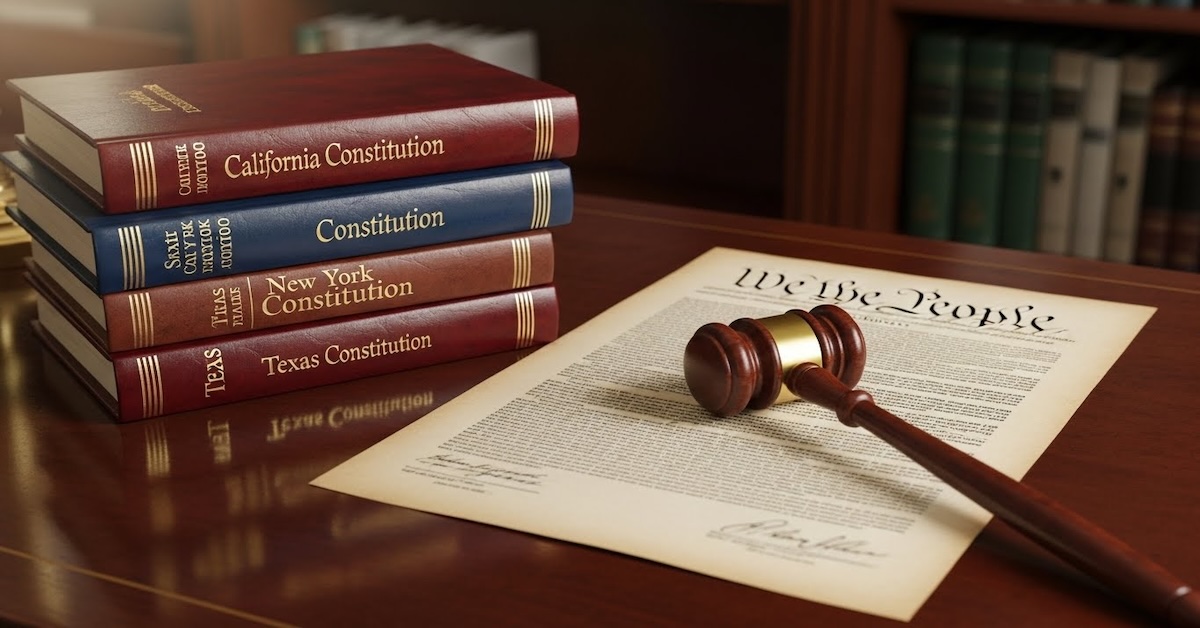

State constitutions differ from the U.S. Constitution in length, detail, and amendment process. The federal Constitution is a short document that sets out the structure and limits of the national government. At the same time, state constitutions average about 39,000 words, address state-specific issues such as education and local governance, and are generally easier to amend than the federal document.
The United States Constitution defines the structure of the national government and dictates the scope and limitations of its powers. Known as “the supreme Law of the Land,” all other laws are measured against it. The application of its articles and amendments comprises what we call constitutional law.
But the federal Constitution isn’t the only constitutional document governing Americans. Each state has its own Constitution, creating its own body of constitutional law. For paralegal students and legal professionals, understanding these differences is essential for navigating state and federal legal systems.
While state constitutions resemble the federal Constitution in outlining legislative, executive, and judicial branches, they differ significantly in scope, detail, and flexibility. These differences reflect each state’s unique history, priorities, and approach to governance.
Understanding the Constitutional Framework
The U.S. Constitution serves as the supreme law of the land, establishing the framework for the federal government and defining the relationship between the national government and the states. Ratified in 1788, it has remained remarkably stable, with only 27 amendments over more than 230 years.
State constitutions operate under this federal framework. They can’t contradict the U.S. Constitution, but they can provide additional rights and protections beyond those required by federal law. This creates a dual constitutional system in which both the federal and state constitutions govern different aspects of American life.
The Tenth Amendment reserves powers not delegated to the federal government for the states. This allows states to create detailed constitutional provisions addressing local concerns, from education funding to marriage laws, as long as they don’t violate federal constitutional principles.
Similarities Between State and Federal Constitutions
Before getting into where state and federal constitutions diverge, it helps to see where they agree. Every state constitution shares a common structural DNA with the federal document.
- Both establish a republican form of government with elected representatives.
- Both separate power among legislative, executive, and judicial branches.
- Both include a bill or declaration of rights protecting individual liberties, and many state versions predate the federal Bill of Rights.
- Both function as the supreme law within their jurisdiction, with ordinary statutes measured against them.
The differences covered in the rest of this article- length, detail, and how easily each can change- build on this shared foundation rather than replacing it.
Key Differences Between State and Federal Constitutions
State and federal constitutions differ in several fundamental ways. Understanding these differences helps legal professionals navigate both systems effectively.
| Feature | U.S. Constitution | State Constitutions |
|---|---|---|
| Primary Purpose | Grant and limit federal powers | Limit state powers (authority assumed) |
| Average Length | ~4,500 words (original text) | ~39,000 words (varies widely) |
| Total Amendments | 27 (since 1788) | Average ~130 per state |
| Amendment Difficulty | Very difficult (2/3 + 3/4 states) | Varies, often easier via referendum |
| Scope of Topics | Broad principles, federal powers | Detailed policies, local governance |
| Bill of Rights | First 10 amendments | Often, more expansive protections |
Scope and Authority
The federal Constitution grants specific powers to the national government. Everything else falls to the states. This means the U.S. Constitution is designed to empower a limited government, while state constitutions limit an already powerful state government.
State constitutions address matters the federal Constitution doesn’t cover. They establish state education systems, regulate intrastate commerce, define marriage and family law, create local government structures, and set state tax policies. These provisions often include specific policy details rather than broad principles.
A word count note matters here. The figure of about 4,500 words for the federal Constitution refers to the original, unamended text, the Preamble plus seven Articles. Once all 27 amendments are added, the document comes in closer to 7,600 words. State constitutions, by contrast, are already counted in their fully amended form, so the fairest comparison is a roughly 39,000-word average state document against a roughly 7,600-word amended federal one, a difference of about five times, not the even wider gap that comparing the original federal text alone would suggest.
Why State Constitutions Are Longer and More Detailed
State constitutions average about 39,000 words, roughly five times the length of the amended federal Constitution. Some are dramatically longer. Alabama voters ratified a recompiled and reorganized Constitution of Alabama in 2022, replacing the sprawling 1901 version. The current document still runs roughly 338,000 words, making it the longest constitution in the world by a wide margin. California’s tops 54,000 words, while Vermont’s is only about 8,300.
Several factors explain this length difference. State constitutions often include detailed policy provisions that federal statutes would handle. They address state-specific issues such as water rights in western states, gambling regulations, and education funding formulas.
Many state constitutions incorporate operational details that federal law leaves to legislation. They might specify exactly how many judges serve on particular courts, set precise tax rates, or define specific administrative procedures. These details, while constitutional in form, function more like statutory law.
Historical Factors
States have rewritten their constitutions more frequently than the federal government. Some states have adopted entirely new constitutions multiple times. Georgia has had ten different constitutions, Louisiana eleven, more than any other state, and South Carolina seven. Each rewrite often adds new provisions while retaining old language, creating lengthy documents.
The constitutional convention method used by states also affects length. When states convene to draft new constitutions, delegates often want to address current hot-button issues directly in the constitutional text rather than leaving them to future legislatures.
Amendment Process Comparison
The amendment process represents one of the most significant differences between federal and state constitutions. The federal process is deliberately complex and requires broad consensus. State processes are typically more accessible to change.
| Amendment Method | Federal Process | Common State Processes |
|---|---|---|
| Legislative Proposal | 2/3 vote in both houses of Congress | Varies: simple majority to 3/5 vote |
| Ratification | 3/4 of state legislatures (38 states) | Popular vote (referendum) in most states |
| Constitutional Convention | Never used since original | Used regularly in many states |
| Citizen Initiative | Not available | 18 states, 1 currently inoperative |
| Average Success Rate | Very low (~1% of proposals) | Higher, varies by state |
State Flexibility
State constitutions can be amended through several methods. Legislative proposals, constitutional conventions, and citizen initiatives all provide paths to constitutional change. This flexibility means state constitutions respond more quickly to changing social and political conditions.
Some states allow citizens to propose amendments directly through petition initiatives, bypassing the legislature entirely. California, for example, lets citizens place constitutional amendments on the ballot with enough signatures. This direct democracy approach has resulted in California’s lengthy Constitution addressing everything from tax limits to high-speed rail.
Real-World Examples and Implications
The differences between state and federal constitutions play out in practical ways across the country. Massachusetts’ Constitution, drafted in 1780, is the oldest functioning written Constitution in continuous effect in the world. It’s been amended 121 times, adding detailed provisions while maintaining its original structure.
Alabama’s Constitution demonstrates the extreme of state constitutional detail. Voters replaced the 1901 version, which had accumulated more than 900 amendments and covered everything from livestock running at large to whether municipalities can sell peanuts in particular counties, with a recompiled and reorganized Constitution of Alabama in 2022. That recompilation removed racist and duplicative language and consolidated provisions, but it kept the document at roughly 338,000 words. This specificity still requires constant amendments for routine matters.
Georgia has replaced its Constitution ten times, most recently in 1983. Each replacement reflected changing political and social conditions in the state. These rewrites show how states use constitutional reform as a tool for governmental restructuring in ways the federal system doesn’t.
Rights and Protections
State constitutions often provide broader rights than the federal Constitution. Several state constitutions include explicit privacy rights, environmental protections, or education guarantees that don’t exist in federal constitutional law. Courts can interpret these state provisions to provide greater protection than the U.S. Constitution requires.
For example, some state constitutions guarantee free public education as a fundamental right, creating obligations that go beyond federal requirements. Others include environmental protections or worker rights that federal law doesn’t address.
How Constitutional Differences Affect Paralegal Practice
Understanding both constitutional systems matters for paralegal work. Litigation paralegals regularly encounter cases involving both state and federal constitutional questions, requiring knowledge of both documents and how they interact.
Paralegals working in constitutional law need to research state constitutional provisions alongside federal law. A case might turn on whether a state constitutional provision provides greater protection than federal law, requiring analysis of state court interpretations and precedents.
Research Considerations
State constitutional research differs from federal constitutional research. State constitutions change more frequently, so verifying the current version is critical. On pure questions of state constitutional law, the state’s highest court is generally the final judicial authority, unlike U.S. Supreme Court decisions interpreting the federal Constitution. Questions that also implicate federal constitutional or statutory law remain subject to federal judicial review.
Paralegals must also understand how state and federal constitutions interact. If state and federal constitutional provisions conflict, federal law prevails under the Supremacy Clause. But states can provide additional protections beyond federal minimums.
Practical Applications
Civil litigation often involves state constitutional claims. Criminal defense paralegals must understand both federal and state constitutional protections, as defendants’ rights under the Fourth, Fifth, and Sixth Amendments often intersect with state constitutional provisions. Family law, education law, and many other practice areas routinely involve state constitutional questions.
Government and administrative law paralegals work with state constitutional provisions defining governmental structures and powers. Understanding state constitutional law is essential for analyzing whether state agencies acted within their constitutional authority.
Frequently Asked Questions
Can state constitutions contradict the U.S. Constitution?
No, state constitutions cannot contradict the U.S. Constitution. The Supremacy Clause in Article VI establishes that federal law, including the Constitution, is supreme. If a state constitutional provision conflicts with federal constitutional law, the federal provision prevails. States can still provide additional rights and protections beyond those required by federal law.
Why are state constitutions so much longer than the federal Constitution?
State constitutions are longer because they include detailed policy provisions and address state-specific issues. While the federal Constitution establishes broad principles and grants limited powers, state constitutions often incorporate detailed regulations, operational procedures, and specific policy decisions that federal statutes would handle. States also amend their constitutions more frequently, adding to their length over time.
How often can state constitutions be amended?
State constitutions can be amended as often as the state’s amendment process allows. Most states hold amendment votes during regular elections, and some states see multiple amendments on each ballot. The federal Constitution has only 27 amendments in over 230 years, while the average state constitution has been amended roughly 130 times. Alabama’s former constitution, replaced by a rewritten version in 2022, had accumulated more than 900 amendments.
Do all states have bills of rights in their constitutions?
Yes, all state constitutions include bills of rights or declarations of rights. Many state bills of rights predate the federal Bill of Rights and often provide more expansive protections. Some state constitutions include rights not found in federal law, such as explicit privacy rights, environmental protections, or rights to public education.
Can citizens propose amendments to state constitutions?
Constitutional initiative provisions exist in 18 states, letting citizens propose constitutional amendments by collecting a required number of petition signatures. Mississippi’s process is one of those 18, but it’s currently nonfunctional following a 2021 state Supreme Court ruling, leaving 17 states with a working citizen-initiative path today. Other states require amendments to be proposed by the legislature, a constitutional convention, or a constitutional commission before going to voters.
Why do some states have multiple constitutions throughout their history?
States adopt new constitutions to reflect significant political, social, or structural changes in state government. Historical events such as the Civil War, Reconstruction, progressive reforms, and major governmental reorganizations often prompted new constitutions. Georgia has had ten constitutions, Louisiana eleven, more than any other state, and South Carolina seven, each reflecting the state’s evolving needs and political circumstances.
How does understanding constitutional differences help paralegals?
Paralegals need to understand both constitutional systems because many cases involve both state and federal constitutional questions. State constitutions often provide greater protections than federal law, requiring separate research and analysis. Understanding how state and federal constitutional provisions interact is essential for accurate legal research, brief drafting, and case preparation across multiple practice areas.
Key Takeaways
- State constitutions function alongside the federal Constitution but cannot contradict it. They can only provide additional rights and protections beyond federal minimums.
- State constitutions average 39,000 words compared to the federal Constitution’s 4,500 words in its original text, with Alabama’s recompiled 2022 constitution still roughly 338,000 words due to detailed policy provisions.
- The federal Constitution requires 2/3 Congressional approval and 3/4 of the states’ ratification to amend, while most states allow amendments through simpler legislative processes or direct citizen initiatives.
- State constitutions are amended far more frequently, averaging roughly 130 amendments per state compared to just 27 federal amendments since 1788.
- Many state constitutions provide broader rights than federal law, including explicit privacy protections, environmental rights, and education guarantees not found in the U.S. Constitution.
- Paralegals must research both constitutional systems, since cases often involve overlapping state and federal constitutional questions across practice areas such as criminal defense, civil litigation, and administrative law.


Explore Constitutional Law Career Paths
Understanding state and federal constitutional systems is essential for paralegals. Discover how constitutional law expertise can advance your legal career.